No products in the cart.

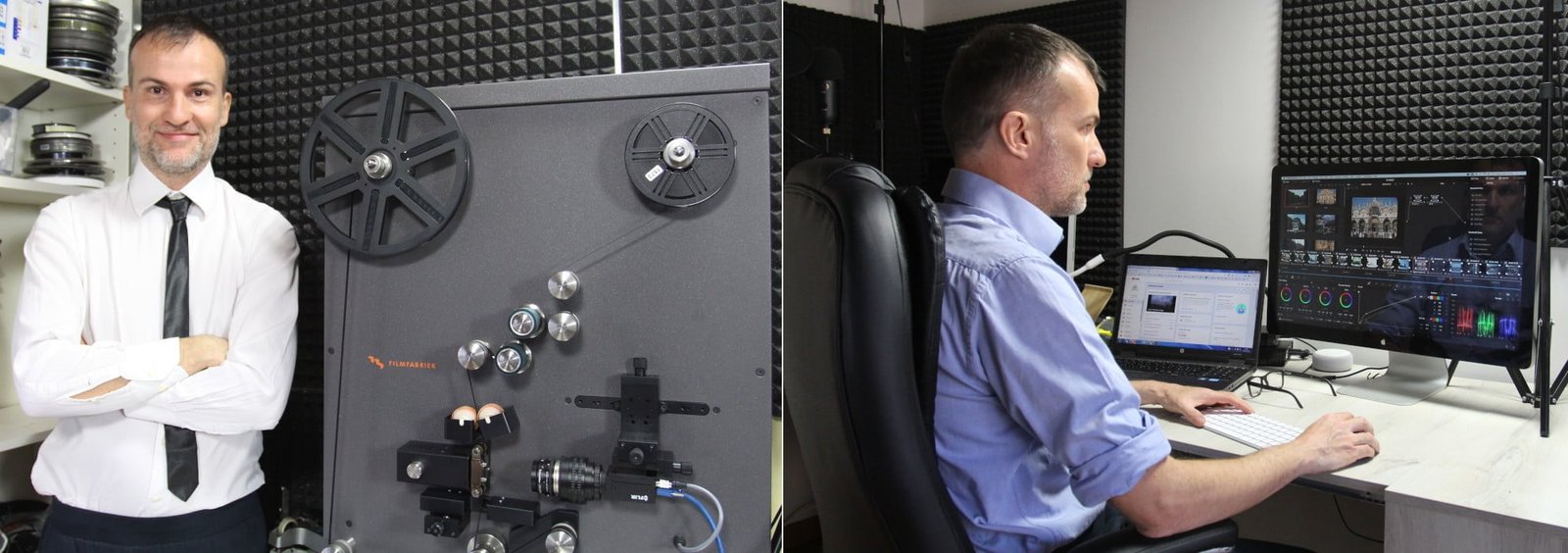
My name is Daniele Carrer. In the 1990s, I aspired to become a professional director. To pursue my dream, I began creating my own short films. After a decade of hard work in my spare time, I managed to secure a position as a story editor for an Italian national TV show. However, I soon realized that this path wasn’t fulfilling my aspirations.
In 2013, I channeled my passion for cinema and history into the creation of an archive films collection. I started by selling my historical footage on microstock websites. However, my ultimate goal was to provide producers and archival researchers with a platform where they could access only high-quality archive videos restored using professional equipment and software skills, carefully curated by someone like me who truly understood their needs.
This led me to launch footageforpro.com, and to my delight, I found people who believed in my vision…
I have been involved in numerous projects, spanning from low-budget YouTube videos to multi-million dollar productions that were broadcast on platforms such as Netflix, Prime Video, Apple TV, Disney+, HBO Max, and BBC.
Would you like me to provide you with some of the names of these projects?
Leonardo Da Vinci (PBS), American Experience: Fly With Me (PBS), Wham! (Netflix), Breaking Boundaries: Science of Our Planet (Netflix), Guillermo Vilas: Settling the Score (Netflix), Murderous History (Smithsonian Channel), How Putin Is Using The Orthodox Church To Build His Power (Vice news Tonight on HBO), STAX: Soulsville, U.S.A (HBO), Menudo: Forever Young (HBOMax), Home – season 2 (Apple TV), Barons (ABC – Australia), The Good Road (PBS), Britain’s Forgotten Wars with Tony Robinson, Le monde dans un tableau: Le chapeau de Vermeer (ARTE), Billy Joel: And So It Goes (HBO).
Please check their closing titles. You will find credits such as “Daniele Carrer Archive,” “Footage For Pro,” or “The Archive Footage”


What’s the difference between my collection and others?
In short:
I have taken a distinct approach to distinguish my archive footage from what you can find on platforms like Shutterstock or Pond5.
To prioritize quality, I purchased a state-of-the-art scanner. Unlike many major microstocks that are flooded with historical footage digitized using equipment costing just a few hundred dollars, I wanted to ensure that whether you’re an archive researcher working on the next 10-million-dollar documentary production or an 18-year-old student starting a filmmaking course, you have access to archive footage of the highest quality for your projects.
It’s essential to understand that the significance goes beyond image definition, sharpness and dust correction.
Today’s technology has provided us with the opportunity to achieve something that seemed impossible just a few years ago. Let me explain.
Modern videos typically have either 25 or 29.97 frames per second, whereas in the past, with 8, 9.5, and 16 mm films, footage was shot at 16, 18, or 24 fps. To address this discrepancy, I have learnt how to use software interpolation.
Take a look at this video:
In contrast to other companies’ footage that simply repeat original frames to go from 16 or 18 to 25 fps, resulting in jerky videos, my software utilizes AI to analyze the scene and generates the missing frames from scratch.
Creating footage using this method is time-consuming and demands years of experience to handle, but it’s essential for producing a new kind of historical footage that combines vintage subjects with modern video quality.
My work on footageforpro.com, the platform where I sell videos ranging from 30 seconds to 20 minutes, attests to the success of this approach.
Now, on this site, I am offering segments ranging from 5 to 30 seconds.
Are you ready to embrace my project?
No products in the cart.